Fake News, Net Neutrality, News, Privacy, Technology

Internet privacy protections must be upheld

Republican senators moved Thursday to dismantle landmark internet privacy protections for consumers in the first decisive strike against telecommunications and technology regulations created during the Obama administration, and a harbinger of further deregulation.

The move means Verizon, Comcast or AT&T can continue tracking and sharing people’s browsing and app activity without permission, and it alarmed consumer advocates and Democratic lawmakers. They warned that broadband providers have the widest look into Americans’ online habits, and that without the rules, the companies would have more power to collect data on people and sell sensitive information.

Read more about this recent ruling at The New York Times.

Take action! Net neutrality is essential to everything we need in our society and democracy — from educational and economic opportunities to political organizing and dissent. Millions of people fought for over a decade to secure lasting Net Neutrality protections. We will not accept anything less. We urge you to reject any attacks on real Net Neutrality.

To make your voice heard in telling lawmakers that net neutrality is not negotiable click here.

Image courtesy of The New York Times.

Fake News, News

Fake news sharing and friendship go hand-in-hand

Everyone is trying to crack down on fake news, but there’s still little understanding of why such preposterous information spreads so easily. One recent study may have revealed a very important piece of the puzzle, however: people trust their friends too much.

The new study, from American Press Institute and The Associated Press-NORC Center for Public Affairs Research, suggests people believe news content more when it comes from friends they trust, regardless of its source. For example, if someone sees an article shared by their best bud Joe from an unknown, unvetted media source, they’re more likely to trust the article’s information than if they saw the same article from a reputable media source shared by someone they don’t know as well. That’s right, this study proposes that the sharer is more important than the outlet when it comes to news.

Read more at lifehacker.

Image courtesy of lifehacker.

Events, Fake News, News

Last call for early bird tickets to NFFTY 2017

Are you planning on attending NFFTY this year? This is your last chance to purchase Early Bird tickets for NFFTY 2017. Ticket prices will go up on March 25, so don’t delay!

NFFTY is the largest film festival for emerging filmmakers, with this year’s festival featuring 257 films from 27 countries. Join us for four days of films, our first ever 360° gallery, parties, panel discussions and more!

The NFFTY 2017 festival will be held April 27 to 30 in Seattle, WA.
For schedule and ticket information, visit www.NFFTY.org.

Click here to buy tickets for NFFTY 2017 now.

Advertising, Fake News, News

Brand safety issues go way beyond YouTube, says Advertising Week Europe panel

HamishNicklinGuardian
Hamish Nicklin, chief revenue officer at Guardian News and Media

AT&T and Johnson & Johnson are the latest big advertisers to halt YouTube ad buys, but the problem of ads and offensive content extends way beyond Google and Facebook, according to a session on terror funding led by The Guardian at Advertising Week Europe.

In the context of yesterday’s terror attack at the Houses of Parliament in London, Hamish Nicklin, chief revenue officer at Guardian News and Media, suggested that the debate, originally titled, ‘If advertising is funding terror, what should we do differently?” should instead ask how advertising and the internet can create a safe, premium environment for marketers.

Blaming the big players for everything is clearly not the answer. Mr. Nicklin suggested that Google and Facebook are just “the tip of the iceberg,” while Anthony Katsur, president of Sonobi, a direct audience platform that works with media companies and not through exchanges, said the issue is about the whole ad tech industry, which, he claimed, is supported by “layers of obfuscation between the brand and the consumer … Suppliers supplying suppliers, supplying suppliers.”

Read more at Ad Age.

Image courtesy of Ad Age.

Events, Fake News, News

Spring events and programs from Seattle area non-profit, Reel Grrls

Reel Grrls empowers young women and gender non-confirming youth from diverse communities to realize their power, talent and influence through media production.

The organization has awesome spring events coming up, including a Finances of Film Panel and Workshop, Snap Webisode, and more summer activities.

View the most recent newsletter about current programs here.

Image courtesy of Reel Grrls.

Education, Events, Fake News, News

Seattle Public Schools and City of Seattle Office of Arts & Culture announce grant from the Paul G. Allen Family Foundation

The Paul G. Allen Family Foundation and Seattle Public Schools (SPS), in partnership with the City of Seattle, will open up new career and college pathways for city youth to graduate from high school “Seattle Ready,” by establishing new media arts courses in the Seattle Public Schools Skills Center. Skills Center courses, taught by industry professionals, will enable students to be competitive in the local workforce and provide the opportunity to live and work in Seattle.

SPS has received a grant of $395,000 from the Paul G. Allen Family Foundation to fund the creation of new Media Arts courses offered through the Seattle Public Schools Skills Center. The grant will be supplemented by an additional $175,000 from the City of Seattle. Providing an initial investment, this external financial support will lead to a sustainable program. The new Media Arts courses will begin in July and students can apply today.

Read more about this grant here.

Image courtesy of the City of Seattle Office of Arts and Culture.

Events, Fake News, News

Common Sense Education to host Digital Learning and Leadership webinar, March 29

Join Common Sense Education for the next Digital Learning and Leadership webinar!

Wednesday, Mar. 29 at 4 p.m. Eastern Time
News and Media Literacy: Building Critical Consumers and Creators
Presented by Kelly Mendoza, Director of Learning and Engagement, Common Sense Education

To Participate in the Live Session
http://home.edweb.net/webinar/news-media-literacy-building-critical-consumers/
Test your system for best quality: www.anymeeting.com/systemtest

In This Session
More and more, young people (and adults) are getting their news online and from social media. There is also the increasingly problematic issue of fake news and determining credible news sources online. In an age of pervasive, fast, and on-demand information, there is a need for educators and parents to teach news and media literacy to kids. In this webinar, Kelly Mendoza, Director of Learning and Engagement for Common Sense Education, will lead us on an exploration of news and media literacy, including:

  • Why news and media literacy is more important than ever
  • Latest research on kids and news
  • What is “fake news” and how to spot it
  • Ways teachers can integrate news and media literacy into their curriculum
  • Rubrics you can use to assess students’ understanding of news literacy

Continue reading “Common Sense Education to host Digital Learning and Leadership webinar, March 29”

Fake News, News, People

Well known media agency features long-time, senior employee as SXSW correspondent

J. Walter Thompson (JWT), a well known marketing and communications brand, is covering the South by Southwest (SXSW) conference for the first time. SXSW is an annual conglomerate of film, interactive media, and music festivals and conferences that take place annually in Austin, TX.

JWT has decided to feature their longest-serving employee, Ginny Bahr, as the media correspondent, as she has been with the agency for 65 years and has seen firsthand the continuous developments within media and technology.

Bahr has worked at the agency since 1951 and is reporting on SXSW from the agency’s New York office, highlighting short videos about some conference highlights. The videos are being posted on Twitter, as well as on a microsite created by the agency, Ms. Bahr won’t disclose her age, but said, "You’d be amazed!"

"I was asked to participate in this current project since I’ve seen technology change so quickly over the years," she said. "I was flattered and a little scared at first, but so far it’s been a lot of fun and I hope my appearances have helped to inform people that can’t be there."

So far, Ms. Bahr said she’s enjoyed seeing "how modern technology has increased at such a rapid rate."

Read more at Ad Age.

Image courtesy of Ad Age.

Fake News, News, People

Students highlight products made by refugees in clever sticker campaign

Two students from a New York high school have come up with a creative way to highlight how refugees have contributed to American life, during a time when refugees and immigration are a hot topic due to the President’s recent travel ban,

Kien Quan and Jillian Young have been going around stores in New York City and pasting "Made by Refugee" stickers on any products that were created by refugee migrants.

Books, food, cars and records have all been adorned. The stickers are available for others to download and share as well. You can download and print a sticker sheet to label products, and follow the campaign’s Facebook page.

"This inspiration came from one of my Facebook rants," explained Mr. Quan. "Reading up on the fact that refugees have always been unwelcomed throughout history, I realized that if Vietnamese refugees did not make it over in the 1970s, we would not have the privilege to rave about today’s newest craze, Sriracha. Afterwards, my partner and I just expanded the idea into many more examples."

Read more at Ad Age.

Image courtesy of AdAge.

Events, Fake News, News

MediaFest 2017 held in Spokane, March 22

The Northwest Alliance for Responsible Media, NWARM, is a media literacy group in the Spokane, WA area. On Wednesday, March 22, 2017 from 8:45 a.m. to 2 p.m. NWARM is holding their third annual MediaFest, held at KSPS Public Television Station.

The one-day event brings together 80-100 area high school students interested in media careers with working professionals from every aspect of Spokane’s media to learn about potential careers and encourage critical thinking about media in students’ lives.

For more information about MediaFest 2017, visit the KSPS website here.

To learn more about NWARM, visit their website here, or follow them on Facebook.

Image courtesy of KSPS.

Bill Update, Fake News, News, Take Action

Update: Digital Citizenship/Media Literacy bill, we need your support!

Yesterday, members of AME went to Olympia, WA to testify in support of the Digital Citizenship/Media Literacy bill. This is when we need your help to comment in support this bill!

Please be sure to go the link for our bill and leave a comment in the comment box. It’s very easy to do and only takes a few minutes. You don’t need to know your district representatives, you only need to give your zip code and your comment will be sent to your district’s representatives.

You can leave your comments here.

Thank you for your continued support!

Fake News, News, Politics, Take Action

Trump’s new budget axes NPR and PBS, take action

On March 16, the Trump administration released its budget outline for 2018, complete with a plan to axe funding for the Corporation for Public Broadcasting, which funds hundreds of local NPR and PBS stations around the country along with many public-media programs.1

This could mean no more NewsHour, no more Frontline, and no more Democracy Now! on your local station. We encourage you to make your voice heard in denouncing this terrible news.

Take action to tell Congress how important public broadcasting is by clicking here.

The Free Press Action Fund is a nonpartisan organization fighting for your rights to connect and communicate. The Free Press Action Fund does not support or oppose any candidate for public office. Learn more at www.freepress.net.

Image courtesy of Free Press Action Fund.

Fake News, News, Resources

Advice for parents on how to help kids make sense of the news media

The Washington Post recently shared an article focused on engaging with children in a way that educates and contextualizes media, especially in regards to sensitive topics of race, violence and others.

Between wanting to be informed and the permeating torrent of media, it’s not realistic to shut it out of your child’s life completely. In teaching our kids good digital citizenship, we don’t want to do that anyway. With a little mentorship, we can help fight the incursion of fake news with what always defeats ignorance: knowledge.

The article includes 11 ways to teach digital literacy to kids, and to help them understand what they are seeing.

  1. Open the conversation. Talk and listen to kids about what they are reading and watching. Share what you are reading as well. Try to put it into context for them. Offer perspective. For kids of all ages, if they are concerned about what they are hearing or reading, be sure they know they can talk with you about the news.
  2. Be proactive. With our country in what feels like a very tumultuous time, don’t let elementary-age kids watch or read the news on their own. They need help processing what they see, and we need to help our kids understand how to at least try to make sense of what they are hearing and how to move forward.
  3. Get specific. While sometimes it feels good to generalize while watching the news with other adults (e.g., “the world is going to hell”), we should be specific about our concerns with our kids. If we are anxious or concerned about the news in general, it is helpful to give reasons the news concerns you.

Read more at The Washington Post.

Image courtesy of The Washington Post.

Fake News, News, Technology

Smart screens and cell phones possibly keeping youth from drug use

A recent article in The New York Times noted the rise in smart screen and cell phone use, at the same time as a decline in drug use among teens.

Over the last ten years, the two have been slowly gaining momentum, and a new study shows interesting statistics. “Monitoring the Future,” an annual government-funded report measuring drug use by teenagers, found that past-year use of illicit drugs other than marijuana was at the lowest level in the 40-year history of the project for eighth, 10th and 12th graders.

Use of marijuana is down over the past decade for eighth and 10th graders even as social acceptability is up, the study found. Though marijuana use has risen among 12th graders, the use of cocaine, hallucinogens, ecstasy and crack are all down, too, while LSD use has remained steady.

Even as heroin use has become an epidemic among adults in some communities, it has fallen among high schoolers over the past decade, the study found.

Read more at The New York Times.

Image courtesy of The New York Times.

Fake News, News, Resources

Fake news tips and tricks

It’s becoming more and more relevant for readers and social media users to distinguish facts from fake news. Recent pieces detailing how to do so are everywhere, but here are just two.

A recent article in Fortune Magazine speaks with several professors and students about the importance of education in resolving this issue.

“I think only education can solve this problem,” said Pat Winters Lauro, a professor at Kean University in New Jersey who began teaching a course on news literacy this semester.

Read more in Fortune Magazine.

Additionally, a piece from The Daily Mail shares tips many teachers are using in identifying fake news lessons:

  • URL look odd? That “com.co” ending on an otherwise authentic-looking website is a red flag. When in doubt, click on the “contact” and “about” links to see where they lead. A major news organization probably isn’t headquartered in a house.
  • Does it make you mad? False reports often target emotions with claims of outlandish spending or unpatriotic words or deeds. If common sense tells you it can’t be true, it may not be.
  • If it’s real, other news sites are likely reporting it.
  • How is the writing? Caps lock and multiple exclamation points don’t have a place in most real newsrooms.
  • Who are the writers and the people in the story? Google names for clues to see if they are legitimate, or not.
  • What are fact-checking sites like Snopes.com and FactCheck.org finding?
  • It might be satire. Sometimes foolish stories aren’t really meant to fool.
  • Think twice before sharing. Today, everyone is a publisher.

Read more at The Daily Mail.
Image courtesy of The Daily Mail.


Fake News, News

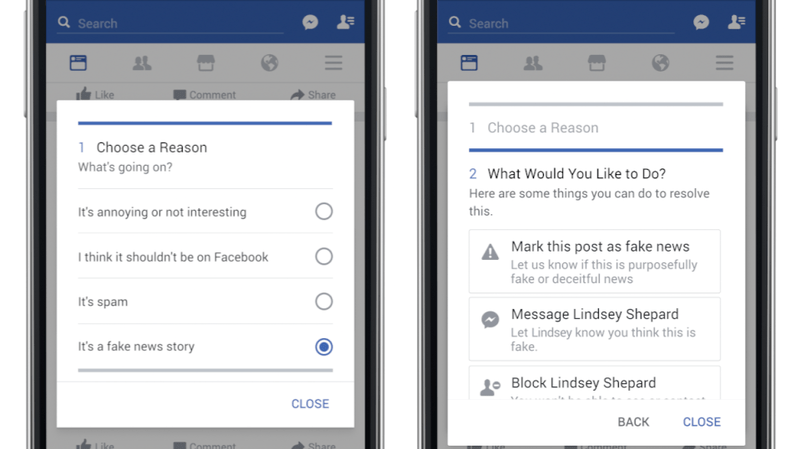
Facebook tackling fake news issue head on

Looking to overcome its own heavy presence in the proliferation of fake news, Facebook is tackling the issue head on, putting together a plan to team up with fact-checkers to vet news items.

In a news release outlining how Facebook’s new reporting and flagging process will work, Mosseri said the company will rely on its users to report a story as potentially bogus, “along with other signals.” The story would then be sent to fact-checkers.

“If the fact-checking organizations identify a story as fake,” Mosseri said, “it will get flagged as disputed and there will be a link to the corresponding article explaining why. Stories that have been disputed may also appear lower in News Feed.”

Read more at NPR.

Image courtesy of NPR.

Fake News, News

Tongue in cheek commentary on unnecessary truth in university papers

Professors and educators are using the haphazard way in which truth was handled during this recent election season to satirize its importance in writing college essays.

Just take a look at Professor Daveena Tauber’s open letter to her students titled “Post-Election College Paper Grading Rubric”. It begins with:

Dear Students,

Because I can no longer claim with any credibility that reading, writing, and critical thinking are essential skills for 21st-century success, I have revised the grading rubric for your papers accordingly. Effective January 20, 2017.

Read more at McSweeney’s Magazine.

abc

Fake News, News

CNN shares article about the plague of fake news

CNN Money has a new piece about how quickly fake news can impact people’s perceptions, despite it’s falsehood, and ways to combat it.

It’s time for a new rule on the web: Double, no, triple check before you share. Especially if it seems too good to be true.

Why? Look no further than Donald Trump’s Twitter account. Trump claimed Sunday morning that “Twitter, Google and Facebook are burying the FBI criminal investigation of Clinton.”

 Not only was there no proof of this, but it was pretty easy to disprove.

Read more at CNN or view the video article below.

cnn fake news

Fake News, News, Social Media

Facebook: World’s most influential news source

imageWhen people talk about mainstream media, how many mention Facebook? In his recent New York Times article, columnist Farhad Manjoo points out that Facebook is now the world’s most influential source of news. Over a billion people check out its News Feed every day and that’s only the very tip of the iceberg! Think about all the online traffic these news items are generating.

Is Facebook in a position to shape world events with its trending news reports?

Read more at the New York Times.

Image courtesy of the New York Times.